Physical Address
304 North Cardinal St.
Dorchester Center, MA 02124
Physical Address
304 North Cardinal St.
Dorchester Center, MA 02124

Explore practical guides and tools for Microsoft 365, Azure, and PowerShell. Enhance your cloud security and admin skills with expert insights and automation tips.
Explore practical guides and tools for Microsoft 365, Azure, and PowerShell. Enhance your cloud security and admin skills with expert insights and automation tips.
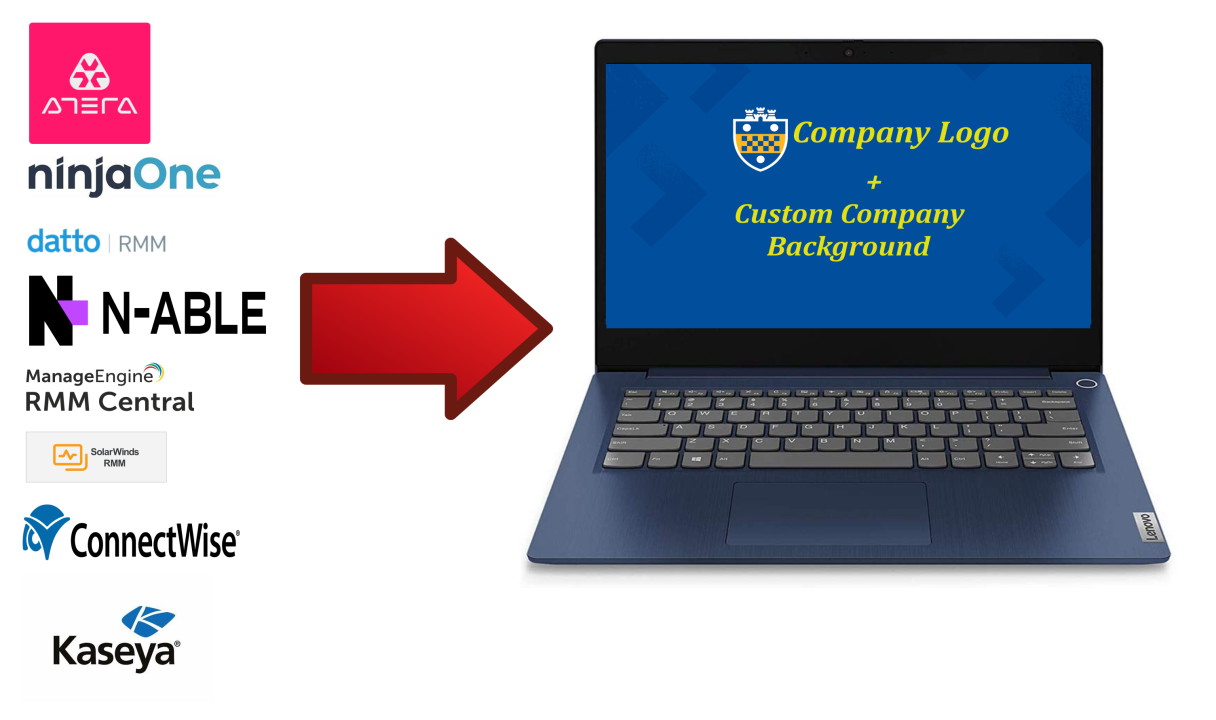

We all know how important it is to maintain a consistent corporate image and communicate information effectively within our organization. That’s why we often use solutions like Intune to set corporate wallpapers and lock screens on all our devices. However, we’re aware that not everyone has access to an Intune tenant.
Today, we’re going to explore an alternative that uses your RMM solution (Datto RMM, N-able RMM, NinjaOne RMM, Atera RMM, ConnectWise RMM…etc) to accomplish the same task. Not only does this method offer the same benefits in terms of brand consistency and information communication, it’s also accessible to those of us who don’t have access to Intune.
We hope you find this alternative solution useful, and look forward to discussing how we can implement it together.
I’ve already written an article on the same subject using Intune, you can see it here :
Intune : Set corporate background and Lockscreen for all Windows joined machines | LinkedIn
In this article, we’ll use the same steps to share the Background and Lockscreen images on an Azure storage account BLOB (I’ve already set up storage accounts if you want more details here’s the link : Create Azure Storage Account and understand the different use cases by examples | LinkedIn) then retrieve the images from an https link and apply them to any machine using PowerShell Scripts deployed with RMM Solution.
After accessing your storage Account, click on the container section and create a new container (you can use an existing container).
See this article to find out how to create a container:
Create Azure Storage Account and understand the different use cases by examples | LinkedIn
I’ll then upload two JPG files, one for the Background and the other for the Lockscreen.

These steps enable you to create a SAS (Shared Access Signature) link to provide secure access to a file stored, for example, in Azure Storage. The SAS link is a convenient way of sharing files without having to give full access to your storage account.

Repeat steps 1 to 4 with the second file and copy the URL into a notepad.
Today, all RMM solutions support PowerShell script execution.
You can just add this script to your RMM Script Library then execute it any time you want.
All you need is to Add your Background URL in the script
$Backgroundlink = “https : // your_full_URL_Here“
Remember this :
The scripts should be executed as Loged-on User and NOT as System
 # Download Directory for background image file
$DownloadDir = "C:\Background\"

# Test if directory exist, otherwise create it
if((Test-Path $DownloadDir) -eq $false)
{
    New-Item -ItemType Directory -Path $DownloadDir -erroraction SilentlyContinue | Out-Null
}

# ----------------------------------------------------- This is the link for the Background file URL
$Backgroundlink = "https://your full URL Here"

$Download = $DownloadDir + "Backgroung-01.jpg"

# Download the background
Invoke-WebRequest $Backgroundlink -OutFile $Download


Function Set-WallPaper($Image)
{
    <#

        .SYNOPSIS
        Applies a specified wallpaper to the current user's desktop

        .PARAMETER Image
        Provide the exact path to the image

        .EXAMPLE
        Set-WallPaper -Image "C:\Wallpaper\Default.jpg"

    #>

Add-Type -TypeDefinition @"
using System;
using System.Runtime.InteropServices;

public class Params
{
    [DllImport("User32.dll",CharSet=CharSet.Unicode)]
    public static extern int SystemParametersInfo (Int32 uAction,
                                                   Int32 uParam,
                                                   String lpvParam,
                                                   Int32 fuWinIni);
}
"@

    $SPI_SETDESKWALLPAPER = 0x0014
    $UpdateIniFile = 0x01
    $SendChangeEvent = 0x02

    $fWinIni = $UpdateIniFile -bor $SendChangeEvent

    $ret = [Params]::SystemParametersInfo($SPI_SETDESKWALLPAPER, 0, $Image, $fWinIni)

}


Set-WallPaper -Image $Download
Same think for Lockscreen, you need just to add your Lockscreen URL :
$Lockscreen = “https : // your_full_URL_Here“
Remember this :
The scripts should be executed as Loged-on User and NOT as System
# Download Directory for Lockscreen image file
$DownloadDir = "C:\Background\"

# Test if directory exist, otherwise create it
if((Test-Path $DownloadDir) -eq $false)
{
    New-Item -ItemType Directory -Path $DownloadDir -erroraction SilentlyContinue | Out-Null
}

# ----------------------------------------------------- This is the link for the Background file URL
$Lockscreen = "https://your full URL Here"

$Download = $DownloadDir + "Lockscreen-01.jpg"

# Download the background
Invoke-WebRequest $Lockscreen -OutFile $Download


# Set Path for Lockscreen image
$LockscreenPath = "C:\Background\Lockscreen-01.jpg"

# Personalization registry Key
$Key = 'HKLM:\SOFTWARE\Microsoft\Windows\CurrentVersion\PersonalizationCSP'
if (!(Test-Path -Path $Key)) {
   New-Item -Path $Key -Force | Out-Null
}

# Set Lockscreen image
Set-ItemProperty -Path $Key -Name LockScreenImagePath -value $LockscreenPath
Thanks